Catharina reports 18-minute OR saving with sedation for sterilisation
A 46-woman trial found no significant recovery difference with sedation, while average operating-room time fell from 61 to 43 minutes.
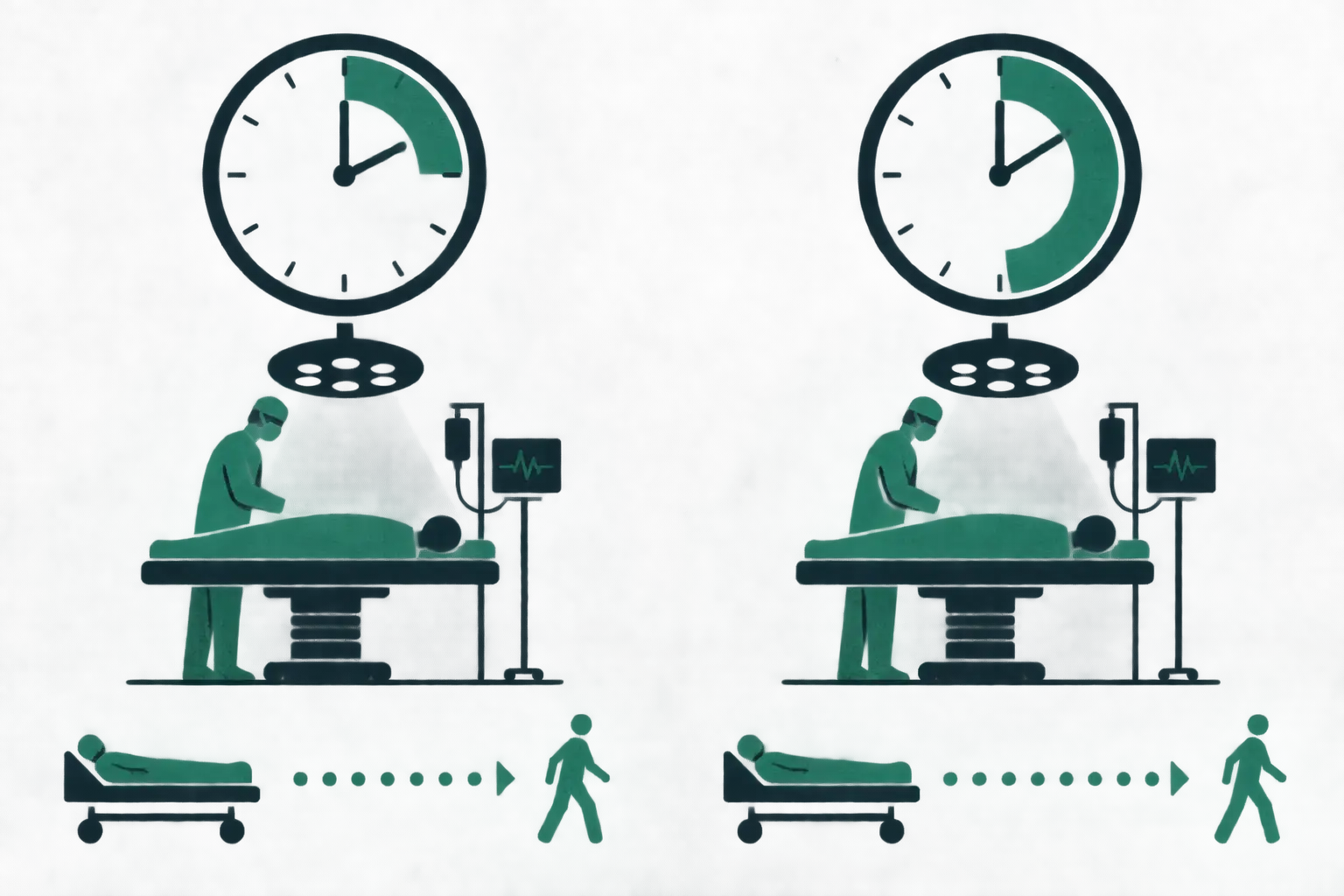
Catharina Hospital reported on 20 November 2026 that sedation reduced average operating-room time for female sterilisation by 18 minutes in a randomised trial, while recovery showed no statistically significant difference at 24 hours or seven days. The hospital said the results were published in the Journal of Minimally Invasive Gynecology.
Sedation reduces operating-room time
Researchers randomly assigned 46 women to general anaesthesia or sedation, with 23 participants in each group, according to Catharina Hospital. Participants did not know their allocation. Average operating-room time was 43 minutes with sedation, compared with 61 minutes under general anaesthesia: a reduction of nearly 30%.
Female sterilisation usually involves laparoscopic surgery to close or remove the fallopian tubes. General anaesthesia is the usual approach, the hospital said. The research team, comprising physician-researcher Hilde Sluijter and gynaecologists Huib van Vliet and Dana Huppelschoten, examined whether sedation could provide an alternative.
Sluijter explained that patients under sedation sleep less deeply than under general anaesthesia, breathe independently and do not require a breathing tube. A specially trained sedation specialist monitors breathing, blood pressure and heart rate. The procedure still takes place in an operating room to maintain sterile conditions.
Recovery findings and safety limits
The reported time saving concerned room occupancy, not faster postoperative recovery. Neither the assessment at 24 hours nor the assessment at seven days found a statistically significant recovery difference between the groups. Painkiller use also did not differ.
The recovery findings likewise should not be read as proof that the two approaches are equivalent in every respect. The trial found no statistically significant difference at the reported follow-up points.
What it means
For operating-room managers and gynaecology teams evaluating sedation for sterilisation, the relevant operational measure is total room occupancy. The result supports examining the anaesthesia pathway as a source of time savings, rather than presenting sedation as a faster-recovery intervention.
Any local implementation assessment must account for the continuing operating-room requirement and specialist monitoring. The approach changes anaesthesia delivery; it does not move sterilisation out of the surgical suite.
For suppliers of anaesthesia and patient-monitoring equipment, the distinction is equally important: independent breathing without a breathing tube still requires physiological monitoring. The immediate implication is a workflow assessment for sterilisation services.